Showing posts with label Fitness. Show all posts

Saturday, May 9, 2020

Can Drinking Water Really Help You Lose Weight?


💦💦 WATER 💦💦

We ALL need it! But how much AND does it really help you lose weight, lean out, etc? Well here ya go! I watched an excellent video the other day with tons of tips and studies explaining how and why it DOES! Here's a bit of it! I'll be hosting a ⚡️⚡️ FREE⚡️⚡️ Water group in a few weeks to help motivate you to CHUG 💧! If you'd like more info, send me a message through this site, in Facebook, Instagram or via email at ellieperico@aol.com! Now....for the details!

Can drinking water help you lose weight/cut fat?

Here are some studies that have been done that prove YES!

1. Drinking half a liter or 17 oz of water increased metabolism from 24-30% for 1.5 hrs!

2. Drinking water before a meal decreases appetite = you eat less!

3. Half a liter before meals lead to 44% more weightloss than people who didn't drink before meals!

4. All metabolic processes that take place in your body work more efficiently with adequate water intake. Think of it in car terms, as the oil for your engine.

How much water should I drink per day? 

The general rule is half your body weight in ounces. So, if you're 150 lbs you need AT LEAST 75oz. More if you're exercising and/or sweating for any other reason, hence losing extra water. 

What if I'm bloated? Do I drink less? 

If you're bloated, that's an indication that you're bloated. DRINK water. It seems ironic but that's your body's signal to give it H20! It retains any water you have anticipating it may not get any for some time. Similar to when you don't eat.

People think if you don't eat you'll lose weight. Not necessarily. Your body's metabolism will slow down and it will create fat stores. 

Should I drink tap, filtered or bottled water?

Ideally, the best option is getting a good quality filter and drinking filtered water from a BPA free bottle. Stainless steel is a great option. It's been estimated that 205 million Americans are drinking contaminated water, including tap AND bottled water filled with pollutants, fluoride, heavy metals and even prescription drugs! 

Bottled water is no better either! I've been drinking bottled water for years and after reading this, I'll be finishing all of the water bottles I have at home and permanently switching to only BPA free bottles like my kids use
.
They did a study that women who had higher BPA levels in their body weighed 40 lbs more than women who didn't. The BPAs are coming from bottled water, plastic containers for food, etc.

Water in general will help with weightloss not only to make you eat less but to make the body function better as a whole. Your digestive system will work better, you'll have more energy, skin will improve and you'll have less headaches. 

So remember, water is a CRITICAL part of your weightloss and/or fitness routine. Drinking water alone won't shrink your belly BUT drinking water and combining that with a proper diet and fitness routine will lead to success, NO doubt! 

Remember, if you'd like to join me 💧💧 WATER ACCOUNTABILITY GROUP 💧💧 contact me! I may be adding a bonus free meal plan with recipes and snack ideas along with daily nutrition and fitness tips just like I do in my client paid groups! JUST in time for summer 🌞👙💦


Monday, November 11, 2019

Top 10 Holiday Health Tips

The holiday season can be quite tempting! Don't let it derail you! Use these tips to help get you through it without ending up carrying extra Lbs come the new year!


Sunday, March 31, 2019

Sweet Potato Crust Spinach, Feta & Egg Frittata 


Ingredients
2 medium sweet potatoes
1 teaspoon canola oil
1 (5-ounce) bag baby spinach
1/2 cup 1% low-fat milk
1/2 teaspoon kosher salt
1/4 teaspoon freshly ground black pepper
1/4 teaspoon crushed red pepper
4 large eggs
2 large egg whites
1.5 ounces feta cheese, crumbled

Preparation:
1. Preheat the oven to 350°, then peel and slice sweet potatoes. I sliced mine using a mandoline, but a knife works great as well. The mandoline speeds up the process significantly and gives you even slices. Coat a pie dish with cooking spray, then fill the bottom of the dish with a layer of sweet potato slices. Cut the sweet potato rounds in half and fill around the edges of the pie dish; round side facing up. Once the entire dish is filled, coat one more time with cooking spray. Bake for 20 minutes. Turn heat up to 375°.

2. For the filling, heat a nonstick skillet over medium heat. Add spinach; sauté 3 minutes. Remove from heat; cool.

3. Combine milk and next 5 ingredients in a bowl; stir with a whisk. Arrange spinach mixture in crust; pour egg mixture over spinach. Sprinkle with feta. Bake at 375° for 35 minutes. Let stand 5 minutes; cut into 4 wedges.

Each serving( 4 total) contains the following:
CALORIES 196 FAT 8.5g (sat 3.5g, mono 3.2g, poly 1.2g) PROTEIN: 12g CARB 18g FIBER 4gCHOL 197mg IRON 2mg SODIUM 562mg CALC 155mg
Via Cooking Light 

Thursday, January 17, 2019

Should You Exercise When You Are Sore?

Even if you exercise regularly, you've felt it: the aching, can't-sit-down-or-lift-my-arm muscle soreness the next day after a workout. That pain you feel a day or two after an intense workout is known as DOMS, or delayed onset muscle soreness, and is caused by muscle microtearing, which helps build muscle fiber and make them stronger. As easy as it may be to use muscle soreness as a reason to skip your next-day workout (guilty as charged!), DOMS is rarely a good excuse to bypass the gym. Here's what you should be doing instead.
  • Don't premedicate. "Don't mask what your body is telling you," says Crunch trainer Tim Rich. He advises clients to not take painkillers before a workout so they can understand how their body reacts to a workout. Taking Advil before your workout could, for example, cause you to push yourself farther than you should go or mask an injury until it's too late. If you're experiencing DOMS after a workout, however, an NSAID or other anti-inflammatory OTC painkiller and icing where you hurt can help.
  • Assess the pain. It's one thing to have DOMS, which is a good thing. But if you finish a workout and feel like you are uncharacteristically sore, or that you've injured yourself, pushing through the pain may not be the best thing. "If you're new to working out, aches and pains are normal," says running coach Eric Chen. However, when workout pain feels more like a burning sensation, it "automatically means stop right there and rest." In addition, Eric recommends seeking out professional advice if you experience an abnormal pain that reoccurs when you exercise again. Make sure you pay attention the difference between an injury pain and normal muscle soreness, and stop and rest if you feel like you've strained something.
  • Eat protein. Muscles are made out of protein, so to shorten the time it takes muscles to heal, try to eat some sort of protein right after you exercise — this will also help you build more muscle over time. Studies have found that recovery drinks that contain protein help decrease muscle soreness compared to normal carbohydrate-based sports drinks.
  • Alternate workouts. Being too sore to work out may be a popular excuse, but it's not always a good one. If you're nursing sore legs from a rigorous hike, spend the next day working on your abs or arms. Allowing an overworked part of your body time to rest while working on another is a great way to optimize your time and ensure that you stay on track. You can also opt for another aerobic exercise or yoga — cardio and stretching can both help soothe your muscles.
No matter how you deal with muscle soreness, it shouldn't last forever. Go see a doctor if you find that your soreness isn't getting any better.
Via Popsugar

Friday, May 25, 2018

Stuffed Bell Peppers


Looking for a healthy, nutrient packed dinner the whole family will love? Try my Turkey Stuffed Bell Peppers. They take a little prep time but they're well worth it. If you know you won't have time in the evening,  you can pre make the turkey filing, stuff the peppers and leave them ready in your fridge to pop in the oven for 10 minutes when you get home.  In one meal, your family will get lean protein from lean ground turkey, antioxidants from pasta sauce, nutrients from fresh bell peppers, healthy carbohydrates from organic brown rice or quinoa and cancer fighting elements from garlic!

Ingredients
Approximate prep time: 1 hour
-- 4 Bell Peppers (any color)
-- 1 lb. Jennie-O lean or extra lean ground turkey (plain, taco or Italian flavor)
-- 2 cups of marinara sauce (homemade or your fave in a jar!)
--1 chopped onion (optional)
-- 1 cup rice or quinoa (optional)
--2 tablespoons of garlic
-- 1/2 cup shredded cheese or 4 slices of cheese (provolone or mozzarella)

1. Begin by rinsing and hollowing out your bell peppers. Try to use bell peppers that are large and round so they can sit well in a glass baking dish. After they're hollowed out, you can either bake them on a cookie sheet for about 20 minutes at 400 degrees to soften them up OR boil them. If you boil them, you'll need a large pot.  Place them in the large pot covered in water. Bring water to a boil and let the bell peppers soften in the water for approximately 15 - 20 minutes.  Once they are done, remove them from the water and place them in a square glass baking dish. For me, baking is easier :)

2. While the peppers are softening, make your rice or quinoa as you normally would. You can make it in a rice cooker or a pot.  Typically it's two parts water to 1 part rice. I make 2 cups of it. Sometimes i have some left over that I just save and eat as a side dish.  It's up to you how much rice/quinoa you want to add. I like mine with about 3 parts turkey to 1 part rice/quinoa.
.
3. As the peppers are softening and rice/quinoa is cooking, brown your onions and garlic (if you want to add them). Garlic is optional.  I add garlic to almost everything but not everyone likes it in this recipe so it's up to you. If bell peppers are on sale and I buy a few extra, I also chop a bell pepper or two and brown it to add to the turkey filling along with the onions and garlic. Adds a little more substance,  flavor and veggies to the recipe.

4. After browning the onions and garlic, cook the ground turkey. I place the chopped onions in a pan for a few minutes then remove them, put them aside in a bowl and cook the turkey in the same pan. Once the turkey is cooked, I add the onions and mix it together.  If you buy the Jennie-O Taco or Italian turkey you won't need to add seasoning but if you buy the plain you may want to add taco seasoning to give it some flavor.

5. Once the rice/quinoa and turkey with onions is prepared, mix it together and add as much or as little of the marinara sauce as you'd like. I typically add about 1/2 cup to a cup but I don't measure. I just go by how I like the consistency.  You are now ready to stuff your peppers. 

6. Fill each pepper up to the rim. Pour a little more sauce on top of each pepper so that it drips slightly down the sides. Then add a dash of shredded cheese or you can add a slice instead. It depends on what I have on hand :). Sometimes all I have in the fridge is string cheese so I grade that and it works just fine ;)

7. Once topped with cheese, heat the oven to 375 and bake for approximately 7-10 minutes or until cheese melts and is a golden brown. Remove from heat, let cool and serve. Enjoy!

*For a low carb option, do not add the rice and stuff simply with turkey and onion blend. Sometimes I make a few of each.  Low carb for me usually without rice/quinoa and rice/turkey for my kiddos. I prefer the rice or quinoa on the side as a side dish :) Hope you love 'em! Comment and let me know what you think! 

Sunday, January 7, 2018

Still Haven't Started Working on Your New Year Goals? It's NOT too late!


It's not too late! Yes, January 1 has come and gone but you can still get on track and start fresh with us tomorrow

Meal plans ✔️ Recipes ✔️ Meal prep guides ✔️ Shopping lists ✔️ Snack ideas ✔️ 1:1 coaching from me ✔️ Daily fitness & nutrition tips ✔️ and more

If you're up for it, send me a message, text me 818-632-6969 or email me at info@fitfluentialmom.com! 

Sunday, October 15, 2017

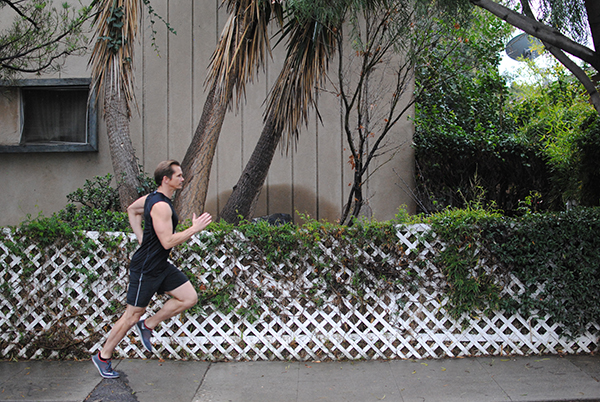
How to Run Faster and Farther!


It doesn’t matter whether you’re a weekend warrior or a veteran racer — if you pound the pavement, odds are you feel a drive to push yourself every time you lace up. It’s goes with being a runner. But we’re also willing to bet that there’s room for improvement in your training program, and that making just a few small tweaks can help you reach your goals faster. Start with the following five. We tapped two of the greatest running minds in the country to discover their secrets for squeezing more from every workout. Follow them, and you’ll not only train smarter and recover quicker, but have more fun while you’re at it.
Rethink Your Warmup
Slow, easy running is sometimes referred to as “junk mileage” because runners don’t see the benefit of putting in training miles at speeds well below race pace. Nothing could be further from the truth. In particular, priming your muscles for hard workouts and races is one of the easiest ways to boost running performance.
“Warming up helps increase circulation and creates heat, which loosens and primes the muscles, joints, ligaments, and tendons for the workout ahead,” explains Jennifer Gill, a Road Runners Club of America coach and certified personal trainer based in San Diego. “That not only means better performance during your run, but also a lower risk of injury.”
Another smart move: Perform dynamic stretches such as lunges, high knees, and butt kicks before you log those warmup miles. Research shows that doing so can improve leg strength, power, and overall running economy.

Mix Up Your Workouts
It’s easy to fall into a routine if you lift weights, but it’s even easier if you run. After all, everyone has his or her favorite routes. If you find that you’re running the same pace, distance, and course every day, it’s time to switch up your training.
“The body needs a balanced [and varied] workout regimen to build endurance, speed, and stamina,” explains Nikki Rafie, a Portland-based coach and two-time Olympic Trials qualifier. “This means your running plan should include tempo runs in addition to long slow distance to improve overall performance.”
Need another reason to pick up the pace? Runners tend to get more enjoyment out of high-intensity workouts than moderate to low intensity workouts, according to a study in the Journal of Sports Sciences. In short, running fast is more fun than running slow, and there’s no shortage of research underscoring the link between fun and athletic performance.

Strength Train
Science is pretty clear when it comes to whether strength training can benefit endurance athletes, yet it remains one of the most overlooked elements of many cardio programs. “Strength training can not only improve speed and power, but it can also help improve cardiovascular fitness, coordination, and efficiency, allowing you to perform the same workouts with less energy expenditure,” adds Gill.
What’s more, strength work can help reduce the risk of running injuries by not only strengthening muscles, but also by reinforcing ligaments and tendons. Just two to three strength sessions per week is all you need.

Make Recovery a Priority
Taking time to recover from tough workouts is just as important as the workouts themselves. If you don’t allow your body time to bounce back, you’ll likely run yourself straight into an injury. “The body is always trying to self-regulate and heal itself, and that’s why rest days are important,” says Rafie. “The joints and muscles need time to rest so the body can heal, rather than breaking down from continuous wear and tear.”
For most runners, this means taking at least one day off from training each week. You should also alternate hard and easy days so that your body can perform optimally in each workout. 

Eat Like an Athlete
Burning tons of calories through regular exercise doesn’t give you a license to eat all of the junk food want—at least, not if you want to achieve your goals. Indeed, targeted nutrition and strategic eating — including taking in the right amount and the right kinds of calories — are essential to increasing energy levels, boosting performance, maximizing gains, and accelerating recovery.
Most people focus on protein intake, but carbs are just as important — especially when it comes to “metabolic recovery,” or topping off the fuel stores your body uses to create energy.
“Taking in the right amount of carbohydrates, protein, and healthy fats between workouts will replenish energy stores, rebuild muscles, and provide enough vitamins and minerals for overall health and wellness,” explains Gill, who is also a license sports nutritionist. “If you don’t, your body won’t be able to perform properly, and will ultimately break down.”

Monday, June 26, 2017

6 Filling Foods That Boost Weightloss


You know the feeling: You’re committed to losing weight and eating healthier, but you’re just so hungry all the time! Argh! Why can’t you lose weight without feeling like a crazy person, constantly ‘hangry’ and perpetually fantasizing about “forbidden” foods? Answer: You can. One of the keys to successful weight loss is to fuel your body with foods that not only support your slim-down efforts, but also help you feel satisfied, thus preventing the kind of wanton binging that can sabotage your goals. Here are six that can do exactly that.

Protein: A recent study at the Pennington Biomedical Research Center at Louisiana State University found that eating protein increases satiety in the short term, helping you lose weight in the long term. Since it takes your body longer to break down protein and convert it into energy than it does, say, simple carbs, eating protein can help you feel fuller longer, making you less likely to snack on junk later on. Your goal: Have high-quality protein at every meal — egg whites with breakfast, Shakeology as a snack, and 4 to 6 ounces of your favorite animal or plant protein for lunch and dinner, for example.

Hemp Seeds: In general, seeds are excellent sources of nutrition, containing plenty of fiber, healthy fats, and amino acids. But hemp seeds are one of the few plant-based food sources that contain all nine essential amino acids, making them a complete protein. They’re also rich in omega-3 and omega-6 fatty acids. Like fiber and protein, fatty acids can help increase feelings of fullness, making it easier to lose weight and keep it off, according to a study in the journal Appetite. Sprinkle 1 to 2 tablespoons on a salad, or toss them into your morning smoothie to give it a little more staying power.

Grapefruit: Eating half a grapefruit or drinking 8 ounces of fresh grapefruit juice three times a day can boost weight-loss efforts significantly, according to researchers at the Scripps Clinic, in California. In their 12-week study, participants lost an average 4 pounds. A separate study at The Rowett Institute of Nutrition and Health in England suggests a possible explanation: Grapefruit is a potent source of pectin, a soluble fiber that can help slow digestion and suppress appetite, leaving you feeling fuller longer, and reducing fat storage in the body. But you’ll only find pectin in the pulp, so drink it pulpy. Better still, eat the whole darn fruit!

Eggs: Considered a “perfect” protein by many, eggs contain all essential and non-essential amino acids. And they’re perfect for weight loss. A study from the Biomedical Research Center in Louisiana found that eating eggs at breakfast helped people feel less hungry while also stabilizing their blood sugar levels and helping them eat fewer calories throughout the day. Need some recipe ideas?

Nuts: Since many nuts are high in omega-3 fatty acids, which have been shown to provide several health benefits related to metabolism, immune function, and inflammation, these nutrition powerhouses are ideal when trying to lose weight, eat healthy, and curb hunger. Plus, they’re loaded with protein and fiber, making them a great go-to snack. Just be sure to eat them in moderation. Nuts are calorically dense, so a little goes a long way. Indeed, a handful is all it takes to reap all of the nutrition and weight loss benefits.

Broth-based Soup: The high water content will fill you up for a minimal caloric cost, according to a report by the CDC. That’s a win-win for weight loss. And if you make your own, you’ll be able to control both the ingredients and the sodium content — absolute musts for healthy eating. 

Wednesday, December 28, 2016

This Scale IS My Friend!

 So, most of you know I'm NOT a big fan of scales but the bottom line is, to keep your goals in check you NEED one. And hello.....New Year's Resolutions are around the corner so I'm sure you're all thinking about those goals too!

I don't weigh myself every day but I do weight myself a few times a week to monitor myself and stay on course.  Up until a few months ago, I've had a regular scale that just read weight.  

Weight is fine and all but it's best to have the big picture! Weight PLUS body fat, muscle mass, bone density, water and BMI truly define your progress and give you an accurate picture of your fitness.  The number on the scale when it comes to weight alone is NOT a good representation of your progress.  That's where the EatSmart scale comes in!


I got this scale, the Eatsmart Precicion Body Fat Scale Bathroom Scale w/ 400 lb Capacity and Step Off Technology, and now I don't even care what the number says when it comes to weight!  I'm  more concerned with muscle mass, fat percentage and my BMI.  And I can see that every time I step on it and every time my husband steps on it as well.


Below are a few shots of the scale and the different screens and information it shares.  The scale can hold up to 8 different user profiles and will recognize users as they step barefoot on the scale.


So, if you're on a weightloss or weightgain journey of your own, this is definitely a good investment.  It retails for over $59 but it's on sale now for $24.95 so jump on it!


Wednesday, November 9, 2016

5 Exercises to Help You Burn Fat

When it comes to dropping pounds, most people go about it precisely the wrong way: They underestimate the importance of diet, and overestimate the power of cardio. Jogging, bike riding (not to be confused with cycling), and other low intensity exercises can benefit your heart, lungs, and mood, but they’re the scenic routes to a smaller waist. Reams of studies agree: The cardio-emperor has no clothes (and frankly, he’s looking a little chubby.)
To burn fat, you need a smart, nutrient-dense diet and a workout program that’s packed with exercises that target as many muscle groups as possible. You’ll find five of those exercises—picked by a handful of the nation’s top trainers—on this page. So step away from the treadmill, weave these metabolic super-moves to your workout rotation, and watch the fat melt away.
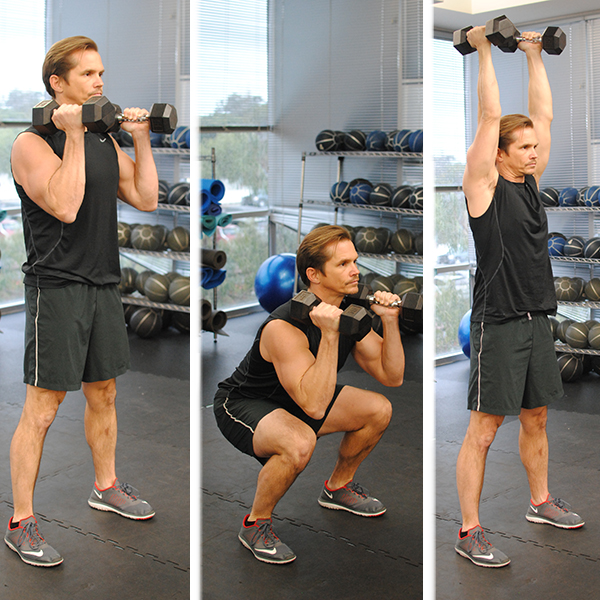
5 Moves for Burning Fat Squat Press
Metabolic Super Move #1: Squat to Press
“Squatting and pressing are both moves that belong in everyone’s workout,” says Rachel Cosgrove, 2012 IDEA Personal Trainer of the Year and author of The Female Body Breakthrough. The squat to press combines them into a single move, hammering your legs, shoulders, and every muscle in between.
Directions: Hold a pair of dumbbells next to your shoulders and stand with your feet shoulder-width apart. Keeping your back flat, push your hips back and squat down until the tops of your thighs are at least parallel to the floor. Pause, then drive through your heels as you stand up and press the weights straight above your shoulders. Lower the weights to return to the starting position. Do three to four sets of eight to 12 reps.

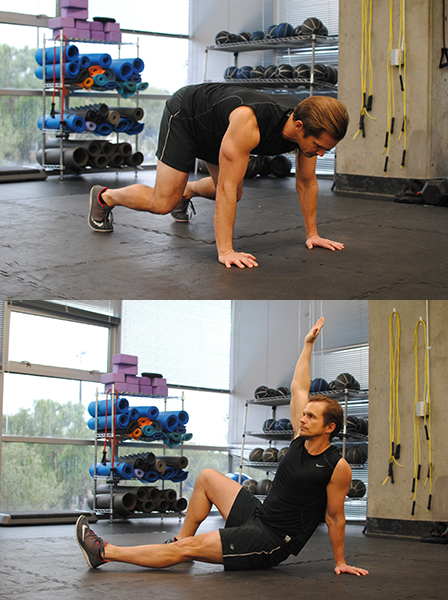
5 Moves for Burning Fat Sit Through
Metabolic Super Move #2: Sit-Through
“Don’t underestimate the value of moving around on the floor for burning fat,” says powerlifter David Dellanave, owner of The Movement Minneapolis, in the Twin Cities. “The sit-through is surprisingly taxing—you’re supporting your entire bodyweight on all-fours and then moving through a wide range of motion while synchronizing the actions of multiple limbs and muscles.” In short, it taxes your body and challenges every aspect of athleticism: Mobility, strength, power, and coordination.
Directions: Assume a bear crawl position with your back flat and the balls of your feet and palms of your hands on the floor. In one movement, pivot your right foot, reach your right arm above your head, rotate your chest toward the ceiling, and slide your left foot underneath your body until it’s flat on the floor. You should now be sitting with your left leg extended and your right leg bent. Raise your hips, and reverse the movement to return to the starting position. That’s 1 rep. Repeat to your other side. Continue to alternate sides with each rep. Do 3 sets of 10 reps.

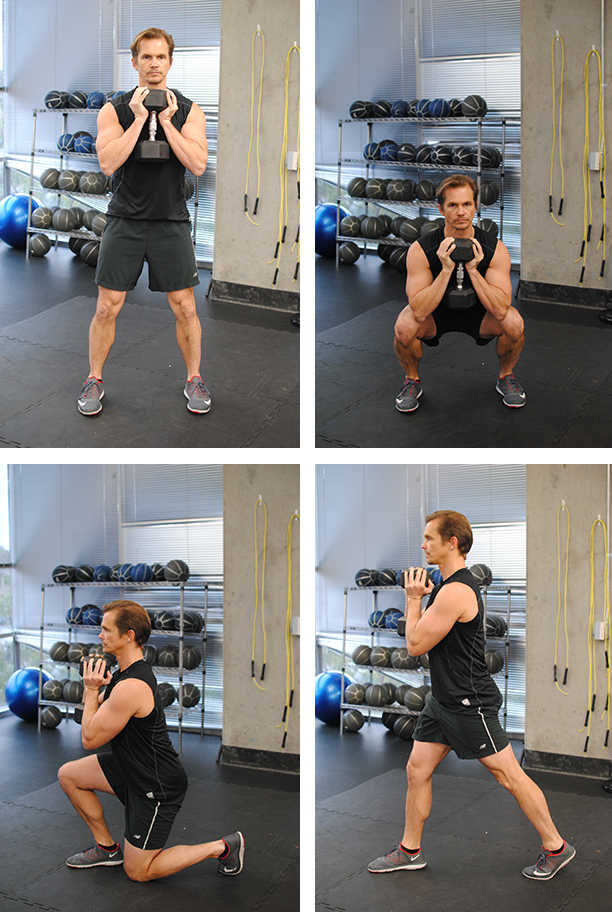
5 Moves for Burning Fat Goblet Squats
Metabolic Super Move #3: Goblet Shooter Squat
This innovative squat-lunge hybrid combines one of the best lower-body moves you can do, the squat, with a rotational element that nails your core. “It’s a killer exercise,” says Dellanave. “You get tremendous time under tension, a huge range of motion, and some good mobility work—especially in your hips.” says Dellanave. “It’s a killer exercise.” And its fat loss dividends are worth every drop of sweat equity.
Directions: Grab a dumbbell and hold it vertically in front of your chest, cupping the top end with both hands (imagine it’s a heavy goblet). Set your feet shoulder-width apart. Keeping your back flat, push your hips back and lower your body until your hips drop below knee-level. Rotate to your right, dropping your left knee to the floor, and then stand up. Reverse the move, lowering your body, rotating back to center, and then standing up. That’s one rep. Repeat the entire sequence, this time rotating to your left and dropping your right knee to the floor. Continue alternating sides. Do 3 sets of 10 reps.

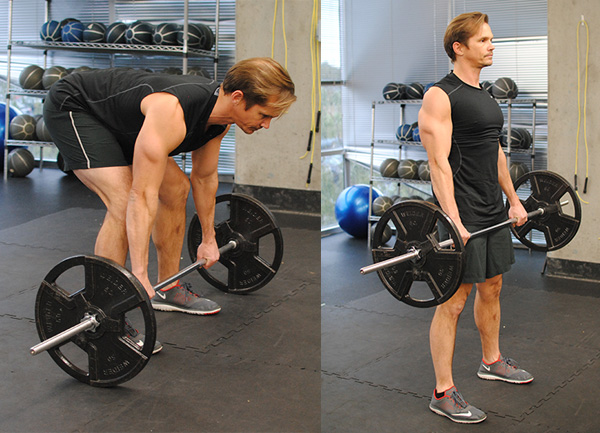
5 Moves for Burning Fat Deadlift
Metabolic Super Move #4: Deadlift
“In the hierarchy of fat loss, resistance training comes right after nutrition, as it has the largest impact on metabolism,” says Craig Rasmussen, C.S.C.S., a trainer at Results Fitness in Santa Clarita, California. And no exercise works more “metabolically active tissue” (AKA muscle) than the deadlift, which targets your glutes, hamstrings, quads, core, back, and shoulders. “It’s a true total body exercise, which is exactly what you need when training for fat loss,” says Rasmussen.
Directions: Load a barbell with moderately-heavy to heavy weights and roll it against your shins. Keeping your back flat, push your hips backward, bend your knees slightly, and grab the bar using an overhand grip with your hands just beyond shoulder-width. Drive through your heels, pulling your torso back and up and thrusting your hips forward as you stand up with the bar. Pause, and then slowly lower the bar back to the floor, keeping it as close to your body as you can. Do three sets of 8 to 10 reps.

5 Moves for Burning Fat Sprint Intervals
Metabolic Super Move #5: Sprint Intervals
“It’s easy to spot a sprinter,” says Angelo Poli, ISSA, owner of Whole Body Fitness in Chico, California. “Even compared to other athletes, they look muscular and lean.” Since you’re working your largest muscle groups (the quads, glutes, and hamstrings) at a near-maximal intensity through a large range of motion, sprinting challenges your fast-twitch muscle fibers like few other exercises. “That’s good news,” says Poli. “Fast twitchers are the fibers with the most potential for both growth and serious fat-burning.”
Directions: Head to the track at your local high school or university. If you’re already fit, run 400 meters (one lap) as fast as you can, and then walk 200 meters. If you’re just starting out, run 200 meters (half a lap) as fast as you can, and then walk 200 meters. Either way, that’s one interval. Do four to eight. Don’t have access to a track? No worries—perform the workout on a smooth even trail, sidewalk, or beach, and measure each interval by time instead of distance. Sprint for 20 to 60 seconds (depending on our fitness level), and then walk for an equal amount of time to complete one interval.

Friday, September 16, 2016

What Should I Eat Before I Workout?

The answer depends on two factors: your overall diet and how intense your workout is. If you eat small, balanced meals every few hours while you’re awake, you don’t really need a preworkout meal strategy. Your body should have ample fuel to get you through any workout around an hour or less (longer workouts have specific needs).
However, if you go longer than 3 hours without eating, you should determine your needs based on a few things. First, how hard is your workout? Easy aerobics and other work where your heart rate doesn’t exceed 140/150 bpm (easy yoga, slow jogging, cycling, hiking, etc.) don’t use a lot of fuel (blood sugar and its back-up, glycogen) and can be done effectively on a fairly empty tank. Good hydration (water only) should be all the fuel you need.
Harder workouts, like INSANITYP90X, or really anything in the Beachbody line that is hard for you, all have an anaerobic interval component which burns your limited stores of glycogen. Your body stores glycogen until you need it, but when your diet is very lean, like most Beachbody diet plans are, you will almost certainly deplete these stores before the end of your workout if you haven’t eaten in a while. This condition, called “bonking,” causes your performance to instantaneously plummet.
Here are some general rules to avoid the dreaded “bonk.” We’re not suggesting you eat 3 separate meals in the hours leading up to exercise. Rather, pick the one that best suits your day.
NOTE: If you work out first thing in the morning, check out this article.
3 hours prior to a workout: Eat a well-rounded, light meal. As long as it’s not too many calories (more than 500-ish), most of it will be turned into fuel by the time you begin. Almost any meal in any Beachbody diet plan fits this mold, as you have ample time to digest.
2 hours prior: Eat a light snack that’s mainly carbohydrates. Something that’s 4 parts carbs to 1 part protein with little fat will ensure there’s time to convert it into glycogen. “Energy foods,” something like granola with yogurt and fruit, is ideal.
1 hour prior: Eat very light, no more than 200 or so calories at around a 4:1 carb to protein ratio. Low-fat, plain yogurt with a little fresh fruit thrown in is ideal. Any extra protein and fat will hinder your workout. It’s similar to the 2 hours prior snack, but since your body can only convert 200 to 300 calories into energy in a given hour you’ll want to keep the portions smaller.
Less than 1 hour: Try not to eat during the last hour before your workout. If you haven’t eaten in hours, liquid fuels, like juice, or easily digestible carbs, like half of a banana, will digest fast enough to help you during the later stages of the workout when your glycogen would otherwise run out. This is also a good time for targeting caffeine intake for ergogenic benefit. Better still, Beachbody Performance Energize includes low-dose caffeine with beta-alanine and quercetin. It also contains 15-30 carb calories, depending on your dosage.

Monday, June 20, 2016

What Should I Eat If I Exercise First Thing in the Morning?


“What should I eat if I work out first thing in the morning? I eat several small meals throughout the day, but when I work out first thing in the AM, it has been hours since my last meal.” —David A.
You’re not alone. I get a lot of similar questions. Morning eating is tricky because your body can store glycogen overnight so you may not need to eat anything at all — just drink water. However, when your diet is lean and you’re training hard (a very common scenario for Beachbody-ers) you can use up all of your glycogen for the previous day’s recovery, leaving your tank empty when you wake up. Here is our standard recommendation for this situation.
Try eating a banana (or half, depending on your size) or a serving of Energize in the morning just before your workout. If you feel better during your workout, especially near the end, you’ve figured out that you’re running out of glycogen. If this is the case you can do one of two things: keep eating the banana or something similar (about 100 calories of mostly carbs) or add a serving of carbohydrates (rice, sweet potato, etc.) to your evening meal. Both should accomplish the same thing.
When your workout is over, you’ve burned through your glycogen and want to replenish it, which means either Results and Recovery Formula for breakfast or a meal that’s mainly carbs with a little protein, like fruit with yogurt or cereal with milk.


Saturday, August 22, 2015

Top 20 Foods That Help Gain Muscle and Burn Fat

To build muscle & lose fat, you'll need to consume a balanced diet complete with lean protein, veggies, fruits, complex carbs and healthy fats. Yes, fats. Fat is not what makes you fat, contrary to popular belief and you NEED it in order to build and maintain muscle.  Protein is another key nutrient you need to help aid in fat loss since it has a higher thermic effect than carbs and fats. This means, after consuming it, your metabolism works slightly more efficient, thus leading to more efficient fat loss.  

When you eat healthy fats, your body holds onto less fat.  Eating fats tells your body it's not in starvation mode, it's going to keep getting fat so it can let the fat you have go....no need to store if for the winter!  Fruits and veggies are just necessary as well.  They help you recover from grueling workouts and fuel your muscles so you have steam when you get to the gym.  

Many struggle to consume all of these foods, each day, throughout the day but you really don't have to.  Just choose wisely and add foods to your daily diet that will give you each of these nutrients in the most efficient way! Information is key and knowing WHAT to eat will help you reach your goals much sooner! 

Here's a list of the top 20 foods that help you build muscle and burn fat!

1. Whole Eggs: Cheap & rich source of protein: 7g/egg. The yolk contains most nutrients: half the protein, vitamins A/D/E and cholesterol to naturally increase your testosterone levels. Don’t worry about cholesterol in eggs. Dietary cholesterol isn’t bound to blood cholesterol. If you have bad cholesterol, lower your body fat rather than throwing the yolk away.

2. Fish Oil: Reduces inflammation (joints/skin), lowers body fat and increases testosterone levels. You need 9000mg EPA/DHA per day. Since you’ll probably struggle to get that from eating fatty fish, consider a fish oil supplement. 

3. Wild Salmon: One of the best sources of omega-3 fatty acids that also gets you 20g protein per 100g serving. Farm raised salmon is, however, omega-3 deficient: it’s corn/grain fed. Go with wild salmon. 

4. Berries: Strong antioxidants that prevent cancer, heart & eye diseases. Any kind works: cranberries, raspberries, blackberries, blueberries, etc. Buy fresh or frozen berries and mix with oatmeal or a protein/nutritional shake. 

5. Yogurt: Contain bacteria that improve your gastrointestinal health. Don’t buy frozen yogurt or yogurt with added sugar and fruits at the bottom. Get plain low fat yogurt. Eat it with berries, flax seeds, honey, steel cut oats, fresh fruit, etc.

6. Flax Seeds: Source of fiber, protein & omega-3. Grind the flax seeds to get the most out of them. Take 1 tbsp with yogurt & berries before going to bed. Stay away from flax oil: it’s unstable and contains no fiber. 

7. Extra Virgin Olive Oil:  70% monounsaturated fats that protect against heart diseases and cancer. Add 1-2 tbsp olive oil to your salads. Buy Extra Virgin Olive Oil: it contains more polyphenols and tastes better. 

8. Mixed Nuts: Contain mono- & polyunsaturated fats, proteins, fiber, vitamin E, zinc, potassium, magnesium, etc. Mixed nuts are caloric dense, great if you’re a skinny guy who wants to gain weight. Anything works: almonds, walnuts, cashews, hazelnuts, … Peanut butter also works as long as you buy natural peanut butter without added salts/sugars. 

9. Virgin Coconut Oil:   Healthy medium chain fatty acids in coconut oil do not circulate in the bloodstream like other fats.  They are sent directly to the liver and converted into energy versus being stored as fat.  

10. Broccoli: High in cancer-fighting phytochemicals and anti-estrogenic indoles. Broccoli is also high in soluble fiber and low calorie, helping fat loss. Eat other cruciferous vegetables for a change: cabbage, bok choy, cauliflower, kale, … 

11. Spinach One of the most alkaline foods. Spinach prevents muscle & bone loss, but also cancer and heart diseases because of its high nutrient profile. Try one of my many Shakeology recipes with loads of spinach in it! 

12. Turkey: If you don’t believe saturated fat is good for you, try white turkey. The leanest beef has about 4.5g saturated fat/100g, while white turkey has close to 0g (that why it’s so dry). Eat turkey with spinach & quinoa. 

13. Quinoa: South American “king of grains”. Quinoa is higher in fiber & protein than rice or oats, tastes a lot better and is gluten free. Buy the whiter grain, it’s better quality. Eat it post workout with meat & spinach. 

14. Oats: Reduce cholesterol, provide you with low-gi carbs for energy, and high in soluble fiber. Try having it post workout. 

15. Tomatoes: High in lycopene, which prevents cancer. The lycopene in tomato paste is 4 times more bioavailable than in fresh tomatoes. 

16. Oranges: Vitamin C to fight diseases, magnesium to lower blood pressure, anti-oxidant beta-carotenes, etc. Avoid drinking processed orange juice which often has added sugars. Eat oranges or make your own orange juice instead. 

17. Apples: Pectin in apples helps weight loss by increasing satiety. Apples are also the strongest antioxidiant after cranberries (eat the peels). Unfortunately apples are one of the most pesticide-contaminated fruits too so go organic when you can. 

18. Carrots: Their huge vitamin A content improves eye-health, especially night vision. Carrots are also rich in fiber, low calorie and taste good, even raw. 

19. Water: Your body holds water if you don’t drink enough so, contrary to what you may thin, the MORE you drink the LESS bloated you'll be. Drinking prevents water retention, helps muscle recovery and prevents dehydration from strength training. Get a water filter and try to drink 2 cups of water with each meal, totaling at least 100 oz per day. 

20. Green Tea: Strong antioxidant and natural diuretic. Green tea also speeds up fat loss, prevents cancer and improves blood sugar & circulation. Drink green tea in the morning instead of coffee. 

So, to wrap this up... the key is to eat every 3 hours. Try to make a habit of having at least 2 cups water with each meal and reaching 100 ounces each day.  If you can, make a habit of having carbs in the morning or early afternoon only and, when possible, have complex vs simple carbs.  They're used more efficiently by the body and having them earlier in the day will guarantee they're burned off, not stored as F-A-T. And junk food (aka treats) are ok but NOT all the time! 85/15 rule remember! 

Monday, August 17, 2015

Top Health Benefits of Virgin Coconut Oil


  1. Coconut oil is filled with MCT’s (Medium Chain triglycerides) in coconut oil can increase energy expenditure compared to the same amount of calories from longer chain fats…Which help you burn stored fat 
  2. The Lauric Acid in Extra-Virgin Coconut oil kills of fungi and bacteria helping you fight viruses.
  3. Coconut can help kill hunger, without you even knowing (drinking this before you eat  can make you eat less and the fatty acids help reduce your appetite.
  4. The oil can help reduce heart disease by lowering your cholesterol.
  5. It’s also amazing for your hair skin and nails.  Use it daily onyour face to reduce the appearance of fine lines and wrinkles.
  6. The fatty acid also increases brain cells to reduce Alzheimer’s. 
  7. The most dangerous kind of fat is the kind that is in your belly…coconut oil reduces abdominal fat.
  8. This is such an inexpensive, non-dangerous way of burning stored fat, reducing your appetite and increasing your energy! Pair this with a healthy diet, workout and Shakeology and you'll most definitely see results in your physical and emotional well being!
NOT a huge fan of “Drinking” the coconut oil? Try heating it up for a few seconds and making it more liquidy to it goes down smoother OR you can also replace your butter with this as the spread, add into your daily shakes or oatmeal!


Thursday, August 6, 2015

Become a Runner in 8 Weeks!

If you've been wanting to start running but just don't know how, this 8 week training program will get you off on the right foot. After about 2 months, you should be able to run 30 minutes (about 2 miles) at a slow, relaxed pace. It's a simple, progressive program that begins with more walking than running, then gradually evolves into more running than walking. 


Once you are able to run 2 miles nonstop, you can continue to increase your running intervals until you're at the distance and pace you want to be at.  Research has shown that this is enough to help you lose or maintain weight, and improve many other important health markers (i.e., your cholesterol, blood pressure, and insulin response).

So, don't be intimidated by these programs. The first 2 miles are the hardest you will ever run, even when you're a seasoned runner. I run 5-7 miles most days and have been doing that for 10 years or so. Even now, I have the hardest time during my runs up until mile 3. 

Here are four key points to consider before you begin the 8-Week Program.

1. If you are over 40, not accustomed to any exercise, or more than 20 pounds overweight, consult with your physician. Unless you have a known health risk, your doctor will probably encourage you to begin a run-walk program, but it's always wise to check.

2. Schedule your workouts. You won't find time for them unless you make time for them. Put them in your phone calendar, computer, daily appointment planner, on the front of your refrigerator, or wherever else you keep your schedule and make them NON-NEGOTIABLE.

3. Expect bad days. Everyone has them, but they pass quickly, and the next workout is often better than the previous one. So stick with the program. Some days you won't want to run. Get out there anyway and do what you can.

4. Don't rush. In the fitness world, rushing leads to injuries and discouragement. Be patient, and go slow. The goal is to reach 30 minutes of continuous running, not to set any records getting there.


WEEK 1

Training tip: To fuel up for your workout, have a piece of fruit or protein bar about 2 hours before you leave.  If you regularly workout and do fasted cardio, have some pre-workout and at least part of a bar. An hour later, drink 8 ounces of water to help keep you fully hydrated during your run. 

WEEK 2 

Training tip: Always walk 2 to 3 minutes for a warm up before you begin your workout, and walk another 2 to 3 minutes as a cool down afterward. Don't stretch before running when your muscles are tight. Save it for after your workout when your muscles are already warm and follow up with more stretching in the evening.

 WEEK 3

Training tip: Breathing is KEY when it comes to running endurance.  Breath in through your nose and out through your mouth and keep this consistent through your run. You'll avoid losing your breath and it helps with cramps as well.

 WEEK 4

Training tip: When it's hot out, run in the early morning or late evening if you can.  The heat and humidity will dehydrate you faster and make you more lethargic so don't be disappointed if you run a lot slower and walk more on hotter days.

 WEEK 5

 Training tip: On occasion, skip running/walking and do a different type of workout instead. Bike for 30 to 40 minutes, try the elliptical trainer in a gym, swim, lift weights, or join a circuit weight-training class. The break from running will refresh you, and you'll learn new skills while developing new muscles.

 WEEK 6

Training tip: Running is a great way to build strong bones, but you also need plenty of calcium--1,000 milligrams a day, or 1,500 milligrams if you're over age 50. Drink a glass or two of low-fat milk per day, or enjoy a cup or two of low-fat yogurt or cottage cheese. Dark green, leafy vegetables such as kale or spinach are another great calcium source.

WEEK 7

Training tip: Beginning runners often develop shin splints or sore knees. These pains should pass quickly if you treat them immediately with ice packs after your workouts. Put a bag of frozen peas on your shins or knees for 15 minutes. If the pain persists, take several days off before beginning your training program again.

WEEK 8

Training tip: If you can help it depending on the city or area you live in, try not to do your workouts on a busy street or during rush-hour traffic. Find low-traffic streets where any exhaust will be dispersed quickly. Ideally, try to run on greenbelts, parks, on bike trails, around reservoirs, etc. 

Like the saying goes, "Success may come quickly to you as a beginning runner, but the race is never won. Run for life."

Via Runner's World